Saturday, February 11, 2012

On the Gothic Series


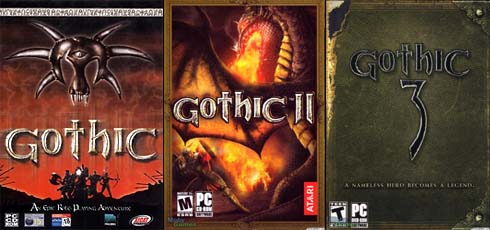
Playing through Skyrim makes me realize how great the Gothic series was (and remains). There's always a void I feel from playing an Elder Scrolls game, and the Gothic games have always been there to remind me of how special a game can be when it's designed properly. I've known this ever since the back-and-forth releases of Gothic in 2001, followed by Morrowind in 2002, followed by Gothic 2 in 2003.

I'll go into more detail about TES in another article. For now, though, I want to take some time to reflect on the Gothic series, to compare each title's relative strengths and weaknesses, and to describe that special Gothic feeling that I often struggle to find in other games. I've written about Gothic before for a "Great Games You Never Played" article, which is worth a read for a more basic overview of the first game. My break-down of the full series comes after the jump.

Tuesday, February 7, 2012

The Lost Crown: A Ghost-Hunting Failure


The Lost Crown: A Ghost-Hunting Adventure is an adventure game by Jonathan Boakes, best known for his previous work on the Dark Fall series. Given the man's reputation within adventure-gaming circles, as well as some really emphatic reviews for the game, including a 4/5 star average from 70 user reviews on Amazon, I had high hopes and expectations for TLC. 

But the game proved utterly disappointing. The pacing is incredibly slow, the characters are completely flat and shallow with some of the worst voice acting I've ever heard, and the plot lacks all form of intrigue and compulsion. To top it all off, the word of mouth claimed that this was a very suspenseful and sometimes scary game, but it's just not. There are a few shining moments within this sea of murky brown, but the whole package is mediocre, at best.

Sunday, February 5, 2012

Kingdoms of Amalur: Demo Impressions


Kingdoms of Amalur: Reckoning launches in a couple of days, and I definitely won't be buying it. It's a pretty good game with an interesting combat system, but judging by the demo, it just doesn't feel like it's worth $60. This is a game that probably needs more than an hour's worth of tutorial and "starting town" quests to get a good impression of, but a lot of its design mechanics just feel off. Like it's the redheaded stepchild of some better RPG that might have been.

The running theme here is "I like it, but...." I would probably only get it with a 75% discount. Even though the full game could be really great, the demo turned me off of paying full price for it. It suffers badly from consolization and just doesn't play like anything I'd expect for a PC release. And a few of its design mechanics explicitly remind me of other games, which only goes to pull me out of the experience and detracts from KOA's uniqueness.

So I've got a run-down of things I liked, things I didn't like, and things I'm on the fence about in the full article. This only reflects my experiences with the demo.

Saturday, February 4, 2012

Great Games You Never Played: The Witcher


"Fine, obscure gems." Part of a periodical series: Great Games You Never Played

In a world where the standards and expectations for RPGs are set by industry powerhouses like Bethesda and BioWare, I always have to turn to the smaller guys whenever I want to play a true RPG. Piranha Bytes and Obsidian get a lot of my respect, but CD Projekt RED added their name to the list in 2007 with The Witcher, a true testament to the glorious PC gaming master race.

You play as Geralt of Rivia, one of the last remaining witchers---a society of monster-hunters who alter their bodies with mutagens to fight supernatural monsters. After an organized group of out-laws infiltrates the witcher stronghold and steals the supply of mutagens, you set out to recover the stolen goods and get to the bottom of the conspiracy, but not without encountering more monsters (both human and beast) and moral conflicts along the way.

What makes The Witcher so remarkable is that it puts a lot of weight on your actions, with many of your decisions having lasting effects on the entire game. Often times you make a seemingly-trivial decision in one chapter, and then it affects a quest in the next chapter. The moral decisions you make are complicated shades of gray with no right or wrong answer. The way you develop your character is important to how you'll play the game. There's a consequence for nearly everything you do. And all of this is done in a rich, mature setting that feels more real than it should.

The Witcher is already well-known among RPG enthusiasts, so there are reasonable odds that some of you may actually have played this one, as contradictory to the article title as that may be. Nevertheless, it's still overlooked by the mainstream and remains more of a cult hit, while getting a lot of criticism from people I would venture to say just don't "get it." So I've got more words on its brilliance (and why you should play it) in the full article.

Sunday, January 29, 2012

In the Bleak of Winter: The Snowfield


There are certain kinds of games that warm my heart, even when their atmosphere is chilling my bones. The Snowfield is one of them. Everything about it makes me feel cold, vulnerable, and depressed as I wander through the stifling aftermath of a recent battlefield, clutching my wounds and fearful of freezing to death as I try to help the grieving and wounded soldiers around me. And yet there's something ever-so-slightly optimistic about it that, in the end, lifts me up from the grim bleakness that I feel from playing it.

Made by students of the Singapore-MIT Gambit Game Lab, The Snowfield is really more of an experiment in video game design than it is an actual "game." It's an interactive experience with a primary goal/objective that you can fail to complete (and thus die), much like any other game, but its general presentation and mechanics might be a turn-off for some. But if you're the kind of person who values and appreciates atmosphere, then this is one you don't want to miss. It's free and can be played here, in your browser with the Unity Web Player plug-in. More of my thoughts after the jump.

Thursday, January 26, 2012

Video Games in TV: Law & Order SVU (again)


"Some TV shows just don't get it." Part of a periodical series: Video Games in TV.

In 2010, Law & Order: SVU took yet another stab at portraying gamers with the episode "Bullseye," in which two video game-obsessed parents neglect their ten year old daughter. Starved and desperate, she escapes their dirty apartment in search of food and gets violently raped by a pedophile. Detectives Stabler and Benson arrive on the scene to interrogate the parents and track down the rapist.

This episode is so bad that I didn't think I'd even be able to sit through it all. The video game stuff only plays a role in the first ten minutes, but this is the kind of ridiculous depiction where I had to pause the video every 15 seconds to make a note of how bad it was. Every line of dialogue, every scene of the game, everything. Just. So. Bad. Fortunately for you, you don't have to watch it. But if you're curious as to how bad it could really be, my break-down awaits in the full article.

Wednesday, January 25, 2012

Digital Distribution: Come on, Man


Last week I was looking to buy a new game ("less than a year old") to play on my new PC. While price shopping, I came to a surprising realization: the retail, physical copy for every game I was interested in was cheaper than a digital download version. Does this make any sense?

I thought digital distribution was supposed to be cheaper than retail, because they don't have to manufacture cases or print box art or manuals. I'm sure it costs money to host things on a server and pay for bandwidth and everything, but they don't have to pay shipping and stocking fees, either. It's like we're being charged for the convenience of a quick and easy download, or something.

So there I was, staring at prices and wondering what was going on. Cheaper prices are always going to sway the direction my wallet goes, but there are other more tangible reasons (literally) that make a physical copy more appealing, especially when the price difference is negligible, and reasons why I would never pay more for a digital version. More on digital distribution (and why it should always be cheaper), including price comparisons of the games I was looking at, after the jump.