Wednesday, February 15, 2012

Let's Talk Skyrim Mods (Part 3)


I originally only planned to post one article on Skyrim mods, but that had to be expanded into two parts because it was a little too long to remain as just one post. And then I figured, since I made "part 2," I may as well go ahead and make a "part 3." So just for the hell of it, "part 3" shall be a list of my favorite absurdly-stupid Skyrim mods. In this article: absurd, ridiculous, hilarious, "wtf," lore-breaking Skyrim mods. Only the best, and only my favorites. (None of that "my little pony" nonsense.)

Be sure also to read the more serious Part 1 and Part 2 of this (apparent) series on Skyrim mods. 

Tuesday, February 14, 2012

Let's Talk Skyrim Mods (Part 2)

Part 2 of the list of Skyrim mods that I'm currently running, with pictures, links, description, and thoughts on each one.  Also a few mods that I tried and didn't like, as well as some works-in-progress that I'm keeping an eye on. Click the article for the full list, or read part 1 here.

Monday, February 13, 2012

Let's Talk Skyrim Mods (Part 1)


With thousands of Skyrim mods out there, I'm rather selective of what I choose to install. Seems like whenever I look through a list of "recently uploaded" mods, most of them are player homes, extra weapons, or things that just break the balance of the game. None of which really interest me. But I still found 29 mods (and counting) that have noticeably improved my Skyrim experience.

For anyone who's looking for a more personal take on mod recommendations, I'll be listing each one I've chosen to run with a brief description of what they all are and what I like about them. As well as others that I didn't really like and others that I'm currently keeping an eye on. As well as discussing my thoughts on the Steam Workshop versus the Skyrim Nexus. Since the list is rather long, with pictures and links and descriptions, I'll be posting this in two parts. 

Saturday, February 11, 2012

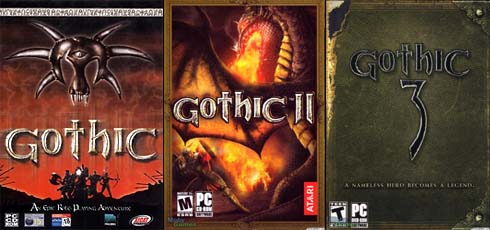
On the Gothic Series


Playing through Skyrim makes me realize how great the Gothic series was (and remains). There's always a void I feel from playing an Elder Scrolls game, and the Gothic games have always been there to remind me of how special a game can be when it's designed properly. I've known this ever since the back-and-forth releases of Gothic in 2001, followed by Morrowind in 2002, followed by Gothic 2 in 2003.

I'll go into more detail about TES in another article. For now, though, I want to take some time to reflect on the Gothic series, to compare each title's relative strengths and weaknesses, and to describe that special Gothic feeling that I often struggle to find in other games. I've written about Gothic before for a "Great Games You Never Played" article, which is worth a read for a more basic overview of the first game. My break-down of the full series comes after the jump.

Tuesday, February 7, 2012

The Lost Crown: A Ghost-Hunting Failure


* this article adapted from my original review on GameFAQs. 

The Lost Crown: A Ghost-Hunting Adventure is an adventure game by Jonathan Boakes, best known for his previous work on the Dark Fall series. Given the man's reputation within adventure-gaming circles, as well as some really emphatic reviews for the game, including a 4/5 star average from 70 user reviews on Amazon, I had high hopes and expectations for TLC. 

But the game proved utterly disappointing. The pacing is incredibly slow, the characters are completely flat and shallow with some of the worst voice acting I've ever heard, and the plot lacks all form of intrigue and compulsion. To top it all off, the word of mouth claimed that this was a very suspenseful and sometimes scary game, but it's just not. There are a few shining moments within this sea of murky brown, but the whole package is mediocre, at best.

Sunday, February 5, 2012

Kingdoms of Amalur: Demo Impressions


Kingdoms of Amalur: Reckoning launches in a couple of days, and I definitely won't be buying it. It's a pretty good game with an interesting combat system, but judging by the demo, it just doesn't feel like it's worth $60. This is a game that probably needs more than an hour's worth of tutorial and "starting town" quests to get a good impression of, but a lot of its design mechanics just feel off. Like it's the redheaded stepchild of some better RPG that might have been.

The running theme here is "I like it, but...." I would probably only get it with a 75% discount. Even though the full game could be really great, the demo turned me off of paying full price for it. It suffers badly from consolization and just doesn't play like anything I'd expect for a PC release. And a few of its design mechanics explicitly remind me of other games, which only goes to pull me out of the experience and detracts from KOA's uniqueness.

So I've got a run-down of things I liked, things I didn't like, and things I'm on the fence about in the full article. This only reflects my experiences with the demo.

Saturday, February 4, 2012

Great Games You Never Played: The Witcher


"Fine, obscure gems." Part of a periodical series: Great Games You Never Played

In a world where the standards and expectations for RPGs are set by industry powerhouses like Bethesda and BioWare, I always have to turn to the smaller guys whenever I want to play a true RPG. Piranha Bytes and Obsidian get a lot of my respect, but CD Projekt RED added their name to the list in 2007 with The Witcher, a true testament to the glorious PC gaming master race.

You play as Geralt of Rivia, one of the last remaining witchers---a society of monster-hunters who alter their bodies with mutagens to fight supernatural monsters. After an organized group of out-laws infiltrates the witcher stronghold and steals the supply of mutagens, you set out to recover the stolen goods and get to the bottom of the conspiracy, but not without encountering more monsters (both human and beast) and moral conflicts along the way.

What makes The Witcher so remarkable is that it puts a lot of weight on your actions, with many of your decisions having lasting effects on the entire game. Often times you make a seemingly-trivial decision in one chapter, and then it affects a quest in the next chapter. The moral decisions you make are complicated shades of gray with no right or wrong answer. The way you develop your character is important to how you'll play the game. There's a consequence for nearly everything you do. And all of this is done in a rich, mature setting that feels more real than it should.

The Witcher is already well-known among RPG enthusiasts, so there are reasonable odds that some of you may actually have played this one, as contradictory to the article title as that may be. Nevertheless, it's still overlooked by the mainstream and remains more of a cult hit, while getting a lot of criticism from people I would venture to say just don't "get it." So I've got more words on its brilliance (and why you should play it) in the full article.